
How FFB prices are set in Indonesia: the K index, extraction rates and a worked example
Context for international readers. In Indonesia, the price mills pay their partner smallholders (plasma and independent smallholders with a partnership agreement) for FFB follows a formula set by the Ministry of Agriculture. The provincial estate crops office (Dinas Perkebunan, or Disbun) issues the resulting price per palm age group on behalf of the governor, based on proposals from a pricing team. Outside these partnerships, prices are negotiated freely, though the Disbun price is still widely used as a benchmark. Indonesian regulations are cited below under their official Indonesian names.
Regulation in force as of 18 October 2026: Permentan No. 13 Tahun 2024 tentang Pembelian TBS Kelapa Sawit Produksi Pekebun Mitra (Minister of Agriculture Regulation on the purchase of FFB from partner smallholders, enacted 20 November 2024). Article 29 of this regulation revokes Permentan No. 01/Permentan/KB.120/1/2018. All example figures in this article are illustrations, not the official price of any region.
Who sets the FFB price
The purchase price of partner smallholders’ FFB is set by the head of the provincial office on behalf of the governor (Article 9). It rests on three inputs: the K index, the CPO and PK extraction rates, and the selling prices of CPO and PK. Proposals come from a pricing team made up of the provincial and district/city offices, mills or business associations, and smallholder institutions or associations (Article 10). The team meets at least once every 2 weeks, while the K index is set once a month (Articles 11 and 12).
The scope is purchases under a partnership agreement between a mill and its partner smallholders, whether plasma or independent. The price set is the price at the mill, excluding haulage from the field.
The FFB price formula
Plasma smallholders
- HTBS(P): the FFB price at the mill received by partner smallholders in the current period (Rp/kg).
- K(P−1): the K index of the previous period (%).
- HCPO(P), HPK(P): the company’s weighted average realised export (FOB) and local selling prices of CPO and PK in the current period (Rp/kg).
- RCPO table, RPK table: CPO and PK extraction rates from the table per palm age group (%).
Independent smallholders
The formula is the same, but it uses a conversion or area extraction rate. Until extraction test results are available, Article 7 applies correction factors to the provincial table rates:
Once extraction test results are available, the partnership agreement can be amended to use them.
Shell value
Shell that is not used as fuel and has economic value can be counted as a shell value (NC) for smallholders (Article 18):
How the K index is calculated
The K index is the percentage share the smallholder receives. Each mill on the team proposes a K index with supporting data, and the team tabulates these on a weighted basis into an average regional K index (Article 13). Annex I calculates it step by step:
- The CPO and PK (FOB) prices minus export taxes and levies and marketing costs give the net FOB price.
- The net FOB price minus haulage to the port gives the net price at the mill.
- The net price is multiplied by the mill’s actual extraction rate and weighted by the export and local share of sales. The result is the weighted average FFB price.
- Step 3 minus the mill’s processing and depreciation costs gives the FFB value at the mill weighbridge.
- That value minus indirect operating costs (BOTL) gives the FFB price at the mill.
Annex I sets BOTL at 1–2%. Its components: cost of money 0.7%, CPO/PK weight shrinkage in transport 0.3%, partnership development costs up to 0.9%, and transport for permanent team members up to 0.1%.
Worked example (illustration)
All figures below are illustrations to show how the formula works. The example assumes all sales are local, so the export share is 0%.
Step 1: the previous period’s K index
| Item (illustration) | CPO | PK |
|---|---|---|
| Net FOB price | Rp 15,200/kg | Rp 12,100/kg |
| Haulage to port | Rp 200/kg | Rp 100/kg |
| Net price at mill | Rp 15,000/kg | Rp 12,000/kg |
| Mill’s actual extraction rate | 21.5% | 4.6% |
| Value per kg FFB | Rp 3,225 | Rp 552 |
Annex I states BOTL as 1–2% without specifying the base of the percentage in detail. This illustration calculates it from the FFB value at the weighbridge; check the base used by the team in your province.
Step 2: the current period’s FFB price
The illustration below uses a K index of 92% (rounded), CPO at Rp 15,000/kg, PK at Rp 12,000/kg, and table extraction rates of 22.0% and 4.5%:
The independent smallholder rates in this illustration are derived from the correction factors: 22.0% × 90% = 19.8% and 4.5% × 110% = 4.95%.
Step 3: price by age group
Table extraction rates differ by palm age, so the price differs by age too. The rates in the table below are illustrations, not figures from the Director General’s table:
| Age (illustration) | RCPO | RPK | FFB price (K 92%) |
|---|---|---|---|
| 4 years | 16.0% | 3.5% | Rp 2,594.40/kg |
| 9 years | 23.5% | 5.0% | Rp 3,795.00/kg |
| 25 years | 21.0% | 4.5% | Rp 3,394.80/kg |
For a real-world comparison: the Riau Disbun price for independent partner smallholders for 22–28 July 2026 used a K index of 92.40%, CPO at Rp 15,664.56/kg and kernel at Rp 14,145.14/kg. Prices ranged from Rp 2,976.93/kg for 3-year-old palms to Rp 3,846.00/kg for 9-year-old palms (see Sources).
How this differs from ramp or collector prices
- Legal basis. The Disbun price applies to mill purchases from partner smallholders bound by an agreement. Ramps and collectors buy without that tie; their prices are free.
- Point of delivery. The Disbun price is the price at the mill. The ramp price is the price at the collection point or in the field, so haulage, loading and unloading, and transfer costs have already been deducted.
- Weight and quality risk. The ramp bears the shrinkage while FFB waits and is hauled, as well as the mill’s grading deductions. Ramps usually pass this risk on through the price or deductions.
- Margin and tax. The ramp takes a margin. When it sells to a mill, PPh 22 withholding tax may also be collected from the ramp (see the ramp article below).
Comparing a ramp price with the Disbun price without accounting for costs and shrinkage is therefore misleading. Compare at the same point of delivery.
Frequently asked questions
Must the Disbun FFB price be used for all growers?
Permentan No. 13 Tahun 2024 governs FFB purchases by mills from partner smallholders, meaning plasma and independent smallholders with a partnership agreement with the mill. Growers who sell without such an agreement, for example through a ramp or collector, are paid a negotiated price. The Disbun price is still often used as a benchmark.
Why does the FFB price differ by palm age?
The price for plasma smallholders uses table CPO and PK extraction rates, and those rates differ by palm age. Young palms have lower extraction rates, so their price is lower too. Table extraction rates are set by the Director General of Estate Crops and reviewed at least once every 5 years.
How often is the FFB price set?
Under Permentan 13/2024, the pricing team meets at least once every 2 weeks. The K index is set once a month. Some provinces, such as Riau, set prices every week.
Does the Disbun price include haulage to the mill?
No. The price set is the FFB price at the mill (Article 17(2)). Haulage from the field to the mill is governed by the partnership agreement or borne by the seller.
How Sawitara helps
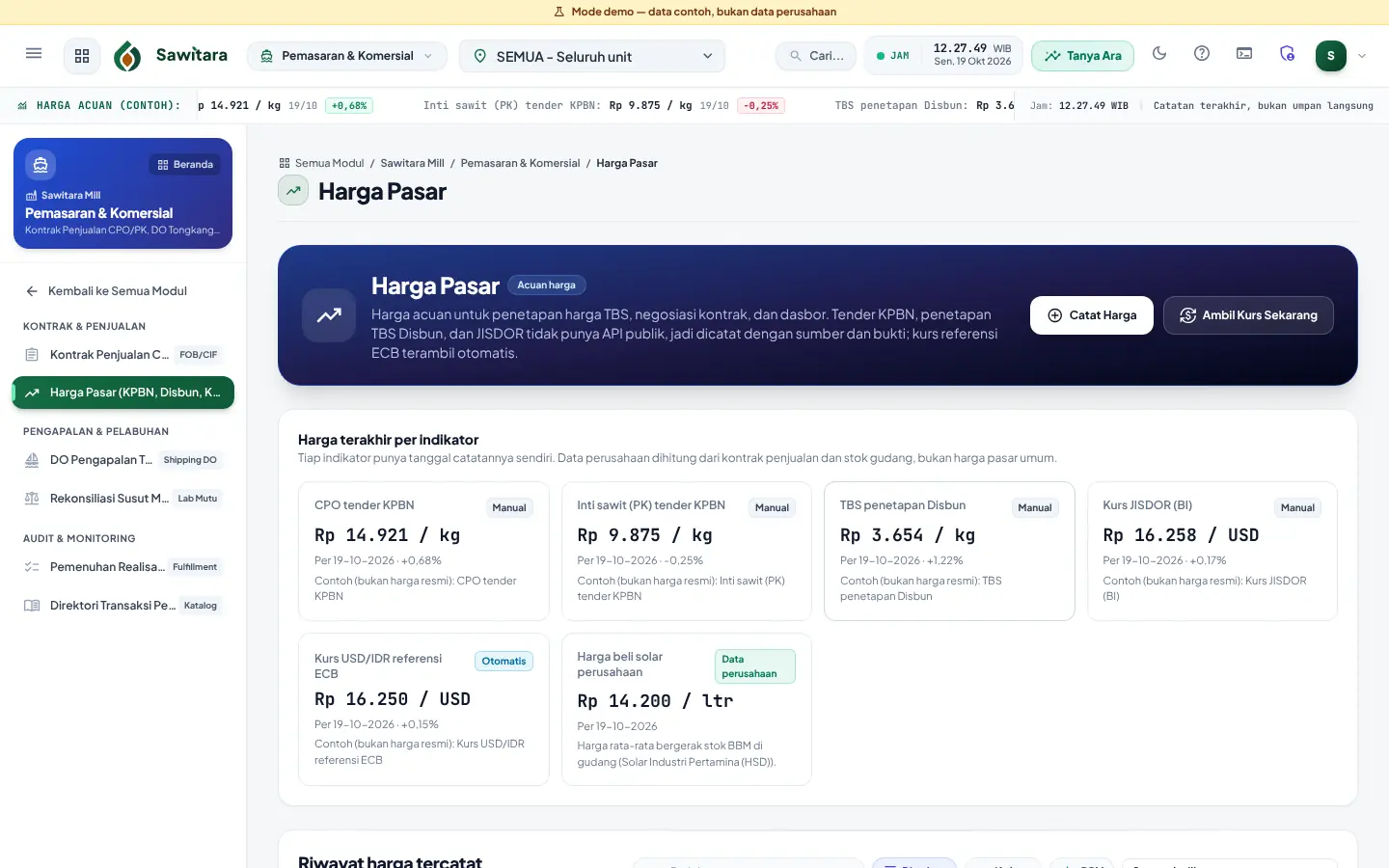
In Sawitara Mill, the Market Prices menu records Disbun FFB reference prices, KPBN tenders and JISDOR exchange rates manually, with source and evidence; Sawitara does not fetch Disbun prices automatically. Plasma FFB purchasing in Sawitara Mill (External FFB module) uses those recorded reference prices for plasma revenue-sharing slips, and growers can see the latest reference price in the Tandan by Sawitara grower portal. For a mill’s own buying price, the public FFB price feature publishes a daily price per palm age group on a page suppliers open from a link or QR code, and third-party FFB purchase slips use that announced price; a different price needs a reason and is recorded. The flow is shown in the FFB Prices & Grower Portal video tutorial. To estimate the value of weight and extraction gaps at your mill, use the ROI calculator, which shows its formulas.
Sources
- Permentan No. 13 Tahun 2024 tentang Pembelian TBS Kelapa Sawit Produksi Pekebun Mitra (JDIH BPK). Articles 7, 9–18, 29; Annex I. In Indonesian. Accessed 18 October 2026
- Teks Permentan 13/2024 di pasal.id. Copy of the text and PDF, in Indonesian
- Ditjenbun: Perkuat regulasi, pastikan harga TBS tidak merugikan pekebun. Directorate General of Estate Crops, in Indonesian
- Haisawit: Daftar harga TBS mitra swadaya Riau periode 22–28 Juli 2026. Cites Kepdirjenbun No. 144/Kpts./PP.320/E/12/2025. In Indonesian
See Sawitara with demo data
In 15 minutes we walk you from estate to general ledger, then discuss the products you need.